

Croatian Bureau of Statistics Eurostat
Prices Rise Again: Croatia’s Inflation Hits 3.8% in November, Double the Eurozone Average
02.12.2025.
02/25/2026

Official Eurostat figures say one thing, while our wallets say something entirely different.
In December 2025, the annual inflation rate in the euro area fell to 1.9 percent, while at the level of the entire European Union it stood at 2.3 percent.
This is a slight slowdown compared with November, when inflation in the euro area was 2.1 percent and in the Union 2.4 percent. But while the European average is falling, many citizens are rightly wondering why going to the store still causes them so much stress.
This is where the abbreviation HICP comes into the story, that is, the Harmonised Index of Consumer Prices.
Economists use this term to make comparisons between countries easier, but for the average person it represents one large, imaginary consumer basket. It includes all the monthly expenses of an average household: food, utilities, clothing, transport, and even services such as haircuts or car repairs.
Annual inflation actually measures the change in the prices of that entire basket between the current month and the same month of the previous year.
So, when statistics say that inflation has slowed, that by no means means that prices have fallen. It only means that they are rising a little more slowly than before. If your average basket last December cost 100 euros, it now costs a few euros more.
It can often be confusing how countries with lower living standards often record the highest inflation rates. The answer lies precisely in the contents of that consumer basket. In poorer countries, citizens spend a much larger share of their meagre income on mere survival, primarily on food and energy. Since food, alcohol and tobacco contributed strongly to price growth in the euro area, with a contribution of 0.49 percentage points, their impact is felt much more strongly in countries where food is the largest item in the household budget.
By contrast, in richer countries people spend a larger part of their wages on other things and services. That is why the lowest annual inflation rates were recorded in Cyprus at 0.1 percent, in France at 0.7 percent, and in Italy at 1.2 percent.
Our country recorded annual inflation of 3.8 percent in December. Although this is a drop compared with November when it stood at 4.3 percent, we are still significantly above the European average. If we look only at European Union countries, Croatia shares this unenviably high position with Austria, which also recorded 3.8 percent.
Ahead of us are only Romania at 8.6 percent, Slovakia at 4.1 percent, and Estonia at 4.0 percent. This means that we are still among the very top in Europe in terms of the speed of price growth.
A comparison with our neighbours is also interesting. Slovenia, which is in the same monetary area as us and also uses the euro, managed to bring inflation down to 2.6 percent. This clearly shows that prices in Croatia rose noticeably faster on an annual basis than in our western neighbours.
When we look at the wider region through Eurostat tables that also include countries outside the Union, we see that our inflation is higher than that in Serbia, which stands at 3.1 percent and North Macedonia where it is 3.6 percent. Montenegro is very close to us at 3.7 percent, while Kosovo is at a high 5.3 percent.
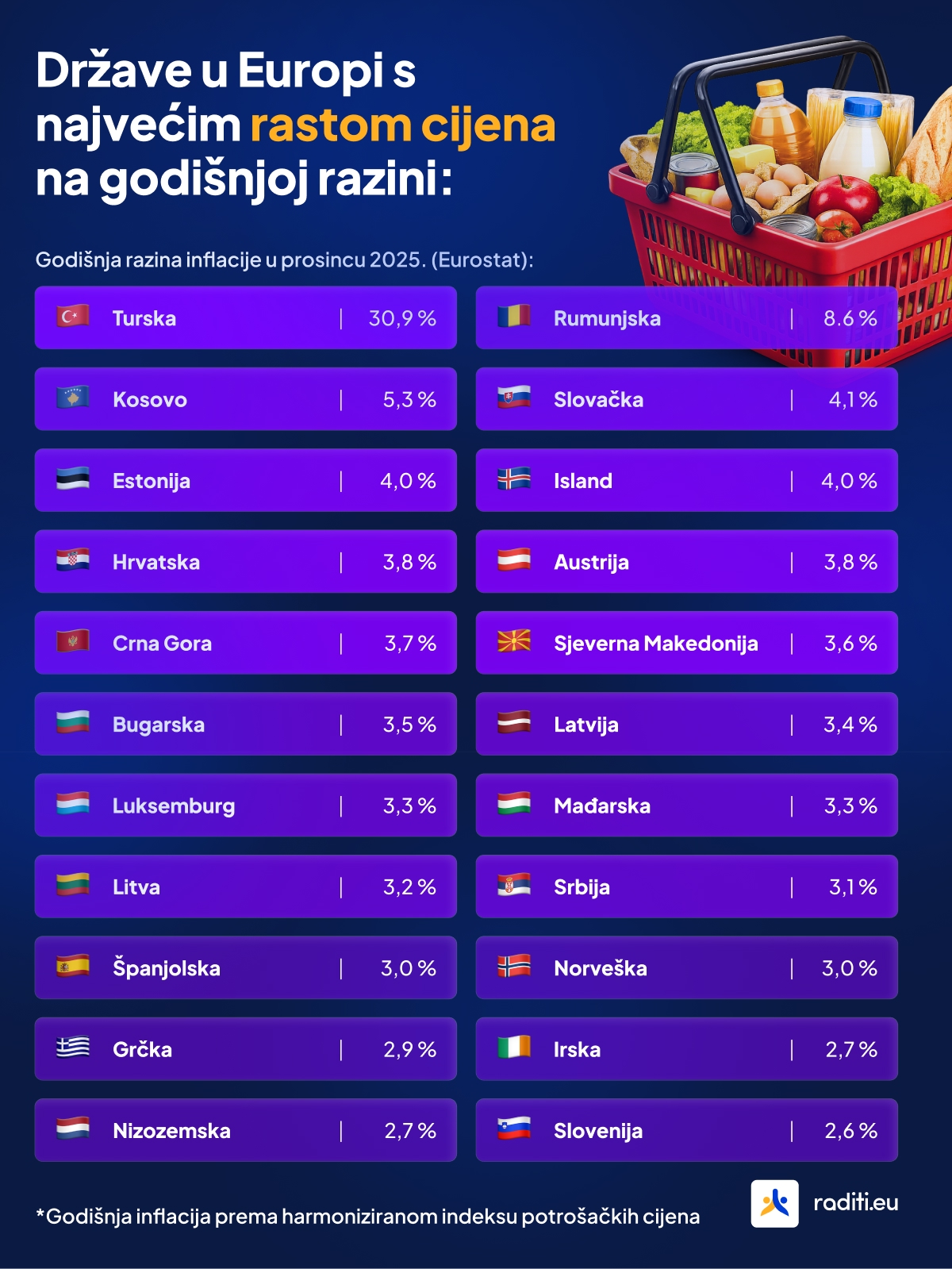
A special story on these lists is certainly Turkey, with an incredible 30.9 percent annual inflation. In its databases, Eurostat regularly also displays countries outside the European Union for a broader picture, with the data referring to a specific moment in time for each of those countries.
To explain Turkey's 30.9 percent in a vivid and simple way, imagine that at the end of 2024 you were spending 100 lira on basic groceries. Today, for exactly the same amount of food, you have to pay almost 131 lira. That is a huge and brutal blow to citizens' pockets, best showing how quickly money loses value when inflation gets out of control.
At the end of the day, macroeconomic figures may show mild optimism for European leaders, but for the average resident, surviving from month to month remains the greatest challenge. Paper can bear anything, but the wallet remembers every price increase very well.