

Croatia Slovenia
Croatia Overtakes Czechia: Average Salary Nears Slovenia’s
21.08.2025.
02/19/2026
It was precisely this wave of interpretations that the Government of the Republic of Slovenia decided to respond to publicly and directly, through posts on its channels, including Facebook and Instagram, with the same message also on other platforms such as TikTok.
In the published visuals titled 'Slovenia and Croatia in figures,' they stated that inaccurate comparisons had also appeared in public, so they therefore presented an overview based on 'official and latest available data,' citing SURS, DZS, and Eurostat as sources.
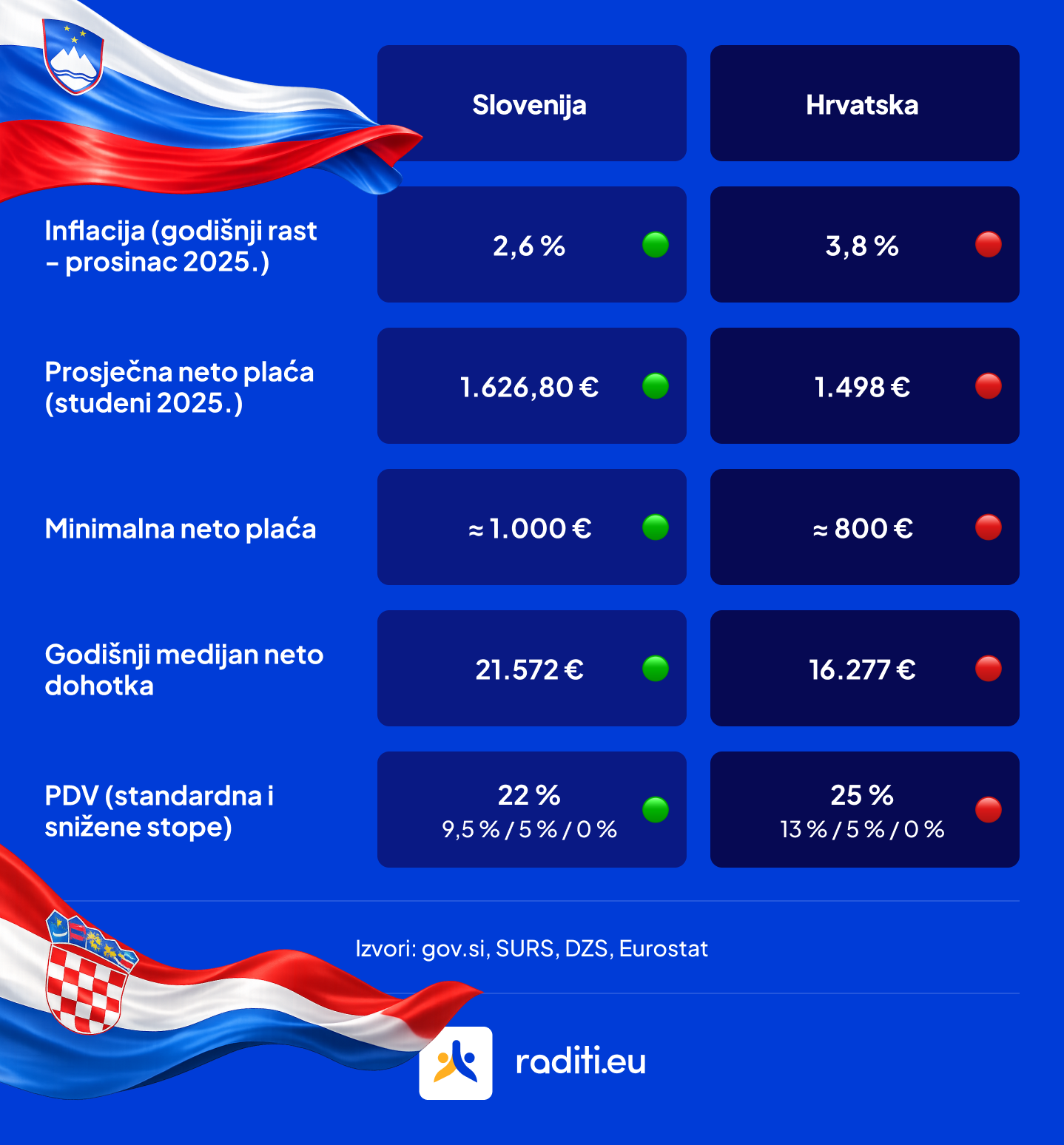
The key figure that is read first is the average net salary. According to data from the statistical offices, the average net salary in Slovenia in legal entities for November 2025 amounted to 1,626.80 euros, while in Croatia for the same month it amounted to 1,498 euros. The difference is about 129 euros in Slovenia's favor, which on paper looks like a moderate advantage, but the Slovenian Government emphasizes that the comparison does not stop at the basic net amount, but that one should also look at the broader package of labor rights and benefits that affect the actual standard of employees.
That is precisely why, in the same set of data, they highlighted several items that in Slovenia have a clearer and more mandatory framework. Meals during work in Slovenia are generally paid as a tax-free allowance, shown at approximately around 160 euros per month, while in Croatia such a payment is not a legal obligation of the employer, although it is possible to pay it tax-free up to a certain annual limit. The same applies to transportation, in Slovenia it is shown as tax-free reimbursement of costs, while in Croatia it is not mandatory, with the possibility of tax-free payment up to the amount of public transport costs.
The biggest difference in that part is the holiday allowance. In Slovenia it is presented as mandatory, and for 2025 in the amount of 1,277.72 euros, while in Croatia it is not a legal obligation, with a lower tax-free threshold tied to total bonuses.
Family social security is another area where Slovenia retains primacy. The display also highlights the length of maternity leave, where Slovenia states 12 months, and Croatia 6 months, where it is important to understand that leave systems differ by phases and rules, so here we are talking about the comparison as the Slovenian Government presented it in its summary.
Although the Slovenian Government states that their maternity leave lasts 12 months, that period is divided into maternity and parental leave. It should be noted that Croatia, in addition to 6 months of maternity leave, also has parental leave lasting an additional 6 or 8 months, with the right to use it beginning after the child reaches 6 months of age. This means that the differences are not as large as the Slovenian Government states.
The second block of comparison refers to the 'broader picture' of the economy and living standards, where the Slovenian message becomes sharper.
Inflation is one of the topics citizens are most interested in because it directly determines how much a shopping basket costs in the store and how much a salary is worth from month to month. In the published comparison Slovenia stands at 2.6%, and Croatia at 3.8%. What is important even for laypeople is that this is the annual rate of price growth, a comparison of the same month with the year before. Specifically, for Slovenia this refers to the harmonized index of consumer prices for December 2025., where SURS states annual growth of 2.6%, and for Croatia DZS in the same month states 3.8% by the same European measure. Simply put, in December prices in Croatia were rising faster than in Slovenia, so the pressure on the household budget was also greater.
The Slovenian Government also places special emphasis on the tax framework through VAT. In the comparison they state that the standard VAT rate in Slovenia is 22%, and in Croatia 25%, with reduced rates in Slovenia of 9.5% and 5%, and in Croatia 13% and 5%, as well as the possibility of a zero rate for certain categories. Higher VAT generally raises the final price of the goods and services we pay for, so the difference between 22 and 25% is not merely technical, but spills over into everyday bills, especially in sectors where the standard rate is predominantly applied.
But the strongest message comes from indicators often used to compare overall living standards. The first is GDP per capita by purchasing power, where Slovenia is at 90% of the European Union average, and Croatia at 78%. This indicator, simply put, shows how developed the economy is per capita when differences in prices between countries are taken into account. According to Eurostat comparisons published by DZS for 2024, Slovenia is thus significantly closer to the European average than Croatia, confirming that the level of economic development in Slovenia is still higher.
The second is the median annual net income by purchasing power. The Slovenian Government states in the comparison 21,572 euros for Slovenia and 16,277 euros for Croatia. In practice, the median is often more useful than the average because it 'cuts off' extremely high and extremely low amounts and shows where the middle of the population is. When it is additionally adjusted for purchasing power, the idea is not only to compare how much someone earns, but how much can actually be bought with that money in their own country. In this indicator, Slovenia has a clear advantage.
Although the Slovenian Government did not include this data in its presentation, a comparison of minimum wages further explains why the Slovenian side still claims that the overall standard is more stable. In Croatia, the minimum gross wage for 2026 amounts to 1,050 euros, which in net terms should be around 800 euros, depending on tax relief and the worker's personal circumstances. In Slovenia, the minimum wage is set at 1,481.88 euros gross, but due to their taxation system the worker receives roughly around 1,000 euros net. That difference is not just statistics, but a concrete indicator that the lower threshold of income in Slovenia is noticeably higher, even when comparing the net amounts that people actually have at their disposal.
All of this comes at a time when a parallel debate is taking place in both Croatia and Slovenia about how the figures should be read. Slovenian economist Mateja Lahovnik emphasizes that the gap between these two countries is narrowing and that Croatia in certain segments, especially when taking into account living costs and the tax burden on labor, may appear more competitive than before. In other words, the fact that Croatia is catching up with Slovenia in certain measures does not automatically mean that the overall picture has already reversed. It is precisely this distinction that the Slovenian Government is now trying to bring back into focus.
Croatia is indeed approaching Slovenia faster than was the case years earlier, but the official indicators that the Slovenian Government drew from SURS, DZS, and Eurostat still show Slovenia's advantage in the level of development, in price dynamics, in the tax framework of consumption, and in the combination of wages and mandatory allowances that raise the actual income of employees. In translation, the debate over 'who overtook whom' may do well on social media, but when the line is drawn and comparable, official data are examined, Slovenia still stands ahead in numerous key categories that matter most to the average person.
In public perception, Slovenia has for decades been regarded as a more orderly and more 'Western'-oriented country, with earlier institutional stabilization and faster catching up with the standards of the more developed members of the European Union. This, however, does not mean that Croatia has not made a major leap forward, because in recent years it has been strongly helped by deeper integration into the EU and concrete development mechanisms. Accession to the European Union in 2013 opened access to the single market, while the introduction of the euro and fuller inclusion in Schengen from January 1, 2023 further facilitated the movement of people and business operations without currency costs and with fewer administrative barriers, while at the same time investments supported by European funds gained greater momentum.
Although the fact cannot be disputed that Croatia in recent years has shown enviable resilience and a faster pace of growth in certain segments, the reality of the figures shows that Slovenia still holds a firm position as the regional leader. Catching up is a real process, but as long as workers' legal rights and overall purchasing power remain on Ljubljana's side, Croatia's overtaking in the full sense of the word will still have to wait for some future statistical reports.
If you are looking for a job in Slovenia, check out the job offers here: https://raditi.eu/?country=SI