




Germany powerhouse
Germany’s Wage Reality: How High Is the Standard of Living, Really?
21.07.2025.
02/17/2026
It seems that what used to be average salaries are now barely enough to cover basic living expenses, and the concept of saving is slowly moving into the realm of unattainable luxury. This painful issue was recently the subject of a heated discussion on the popular social network Reddit, where users shared their monthly expenses completely honestly and anonymously.
The discussion very quickly revealed the harsh truth about how much money in our country has lost its value.
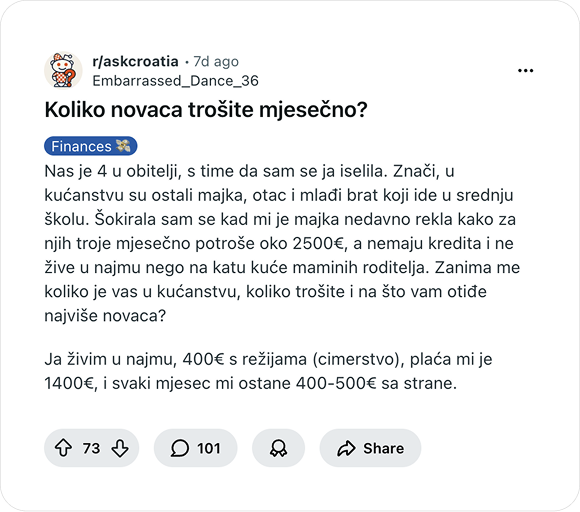
Photo: Screenshot - Reddit
It all started with a post by one girl who moved out of her parents' home and was left in disbelief after finding out how much her family spends. Namely, her mother, father, and younger brother, who attends high school, remained in the household. The three of them spend around 2,500 euros per month, despite having absolutely no loans and paying no rent because they live in her mother's parents' house. On the other hand, the author of the post lives as a tenant, earns 1,400 euros, and manages to save 400 to 500 euros per month.
This drastic disparity perfectly illustrates how much the concept of normal spending has changed. An amount of 2,500 euros without housing costs might sound like real wealth, but nowadays that money disappears at an unseen speed. The basket of basic groceries has become several times more expensive, service prices are rising month after month, and everyday small expenses are imperceptibly draining the family budget.
That the family from the beginning of the story is by no means alone in its financial challenges was confirmed by many other citizens in the comments. Many shared their own calculations that vividly show the decline in purchasing power.
One user described his incredible expenses in detail with the words: 'There are three of us plus pets and we spend around 5,500 euros per month, and I know that very precisely because I have been keeping records for the last six months'.
It is also interesting to observe the expenses of those who live alone. One participant in the discussion stated: 'I most often spend between 3,000 and 3,500 euros per month just on myself. Of that, 800 to 900 euros goes on the car, and the rest on food, restaurants, and travel. I don't pay rent because I bought an apartment.
Another participant explained that living alone with loans creates an enormous financial burden: 'I spend around 2,200 euros on average by myself, and without the apartment and car loans it would amount to around 1,300 euros.
In a sea of serious figures that cause anxiety, Croatians regularly find salvation in dark humor and irony. The comments soon became a ground for jokes at the expense of wastefulness and poor life priorities for which we are often known in the region.
Thus, one user offered an absurdly sarcastic overview of his own expenses and wrote: 'Here is my budget for a family of six. Food costs us one hundred and 20 euros, utilities 80, and clothes and other things about fifty euros. However, we spend between 2,500 and 3,000 euros on betting shops and slot machines, while we have reduced alcohol and tobacco to a modest 600 euros per month.
This hilarious and sharp comment perfectly hits the mentality of part of society and through irony criticizes social problems such as gambling addiction, while at the same time mocking the inability to manage money rationally.
When we step back from individual examples, we come to a well-known fact for which we do not need scientific research. Money in Croatia has become painfully scarce. Its real value has been eroded by inflation that has affected the entire European continent.
Purchasing power, that simple economic measure that tells us how much bread, milk, or fuel we can buy for 1 euro, has fallen drastically. Although statistical data sometimes suggest growth in average salaries, every trip to the store proves the opposite to citizens. Food and basic necessity prices have risen significantly faster than incomes.
The financial reality in Croatia has become a real challenge for survival. While some citizens, with careful planning and sacrifice, manage to preserve part of their income, the vast majority testify to how even above-average salaries melt away in the face of everyday expenses. Discussions of this kind are crucial because they break the illusion that the problem lies with the individual who does not know how to manage money. The real problem is that the cost of living has skyrocketed, and work is not valued to the extent necessary for a dignified and relaxed life. When a family with its housing issue resolved spends two and a half thousand euros just on basic living, it is time to seriously ask ourselves where our economic ship is sailing.