






Croatia salaries
September Earnings Analysis: Average Croatian Net Salary Reached €1,456
20.11.2025.
03/11/2026

According to the latest official data published by the Croatian Bureau of Statistics, the average monthly paid net salary per employee in legal entities in the fourth quarter of 2025 recorded growth in all Croatian counties.
These indicators provide a clear insight into economic trends at the end of last year and confirm the continuation of the positive trend of growth in citizens' incomes compared to the same period of the previous year. Although the figures at the national level inspire optimism, a more detailed analysis reveals significant financial inequalities depending on the place of residence and work.
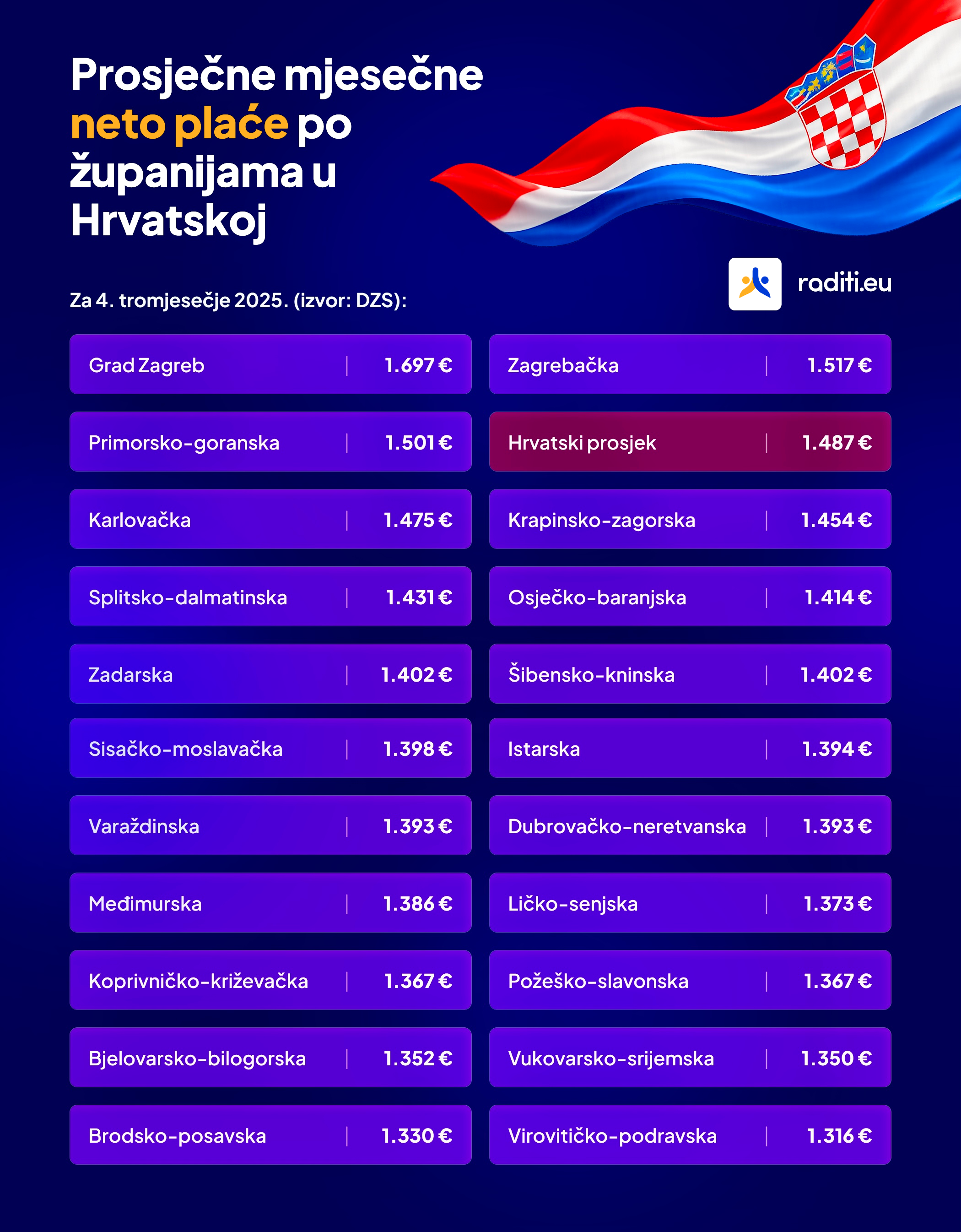
The average monthly paid net salary at the level of the entire Republic of Croatia in the last three months of 2025 amounted to 1,487 euros. The analysis shows that only three administrative units manage to exceed that national average. By far the highest incomes are earned by employees in the City of Zagreb, where the average net salary reached 1,697 euros. It is followed by Zagreb County with an average of 1,517 euros and Primorje-Gorski Kotar County where the average paid net salary amounts to 1,501 euros. All other Croatian regions record incomes below the national average, which clearly indicates a strong centralization of economic power.
At the very bottom of the income ranking is Virovitica-Podravina County. The average monthly net salary paid there in the fourth quarter of 2025 amounts to only 1,316 euros. A slightly better, but still very modest situation is recorded by workers in Brod-Posavina County with an average of 1,330 euros and Vukovar-Srijem County with an amount of 1,350 euros.
By comparing the highest and lowest amounts, one arrives at a striking piece of data on inequality. The difference between the average net salary in the metropolis and Virovitica-Podravina County amounts to a high 381 euros. This means that the average worker in the capital earns more than a quarter more per month compared to a worker in the lowest-paid region, vividly illustrating the depth of regional differences within the country.
When we place the nominal amounts of 1,697 euros in Zagreb and 1,316 euros in Virovitica-Podravina County into a real-life context, the economic picture changes shape dramatically. Real estate market experts and economists regularly point out that high Zagreb salaries are relentlessly eroded by exceptionally high housing costs. While a resident of the capital will often set aside between 500 and 900 euros for the rent of an average apartment or a monthly housing loan installment, housing costs in Slavonski Brod or Virovitica are several times lower.
The price of monthly rent for a spacious and modernly furnished apartment in smaller Slavonian centers ranges around 400 to 500 euros, and the share of families living in their own and inherited properties without loan burdens is significantly higher than in Zagreb. To this should be added noticeably cheaper коммунal services, more affordable prices in local restaurants, and significantly lower expenses for transport and parking. When all the necessary and fixed costs of modern life are deducted from a Zagreb salary, disposable income very quickly becomes equal to that in regions that appear lower-paid on paper.
When it comes to growth dynamics compared to the last months of 2024, net salaries increased in all areas, but the intensity of that growth varies noticeably. The largest jump in net salaries was recorded in Koprivnica-Križevci County, by 11.0 percent. On the other hand, the smallest relative growth of 8.6 percent was recorded in the City of Zagreb. Paradoxically, although the metropolis has the slowest percentage growth, in absolute amounts it still overwhelmingly dominates the ranking.
A similar trend is followed by the movement of gross amounts, which also grew across the entire country. The highest growth in gross salaries of 12.2 percent was achieved in Koprivnica-Križevci and Virovitica-Podravina counties, while the City of Zagreb is at the bottom of the growth ranking with 8.8 percent.
Ultimately, the highest average gross salary was again paid in Zagreb in the amount of 2,458 euros, and the lowest in Virovitica-Podravina County in the amount of 1,777 euros.
The continuous growth of average monthly net and gross salaries is undoubtedly positive news for the Croatian economy and the general standard of citizens. The data from the Croatian Bureau of Statistics unequivocally confirm that incomes are nominally growing in every corner of the country. However, the stable national average of 1,487 euros masks the real financial picture on the ground, where the vast majority of counties lag behind the capital and a handful of more developed units. A financial gap of almost 400 euros in pure net income between the richest and most vulnerable regions is a clear signal to economic policymakers.
These indicators suggest that economic growth continues to spill over asymmetrically, leaving a large part of the country on the margins of economic progress, which requires urgent consideration of new models of balanced regional development.
The official data of the Croatian Bureau of Statistics offer a strong reason for optimism because they prove that incomes in Croatia are rising everywhere, and regions with lower salaries are recording the fastest pace of growth. The nominal shortfall of almost 400 euros between the richest and most vulnerable areas appears discouraging only if read outside the context of the specific features of local economies. Real purchasing power clearly shows that living conditions across the country are far more balanced than bare statistics on paper suggest. Such indicators carry an exceptionally important message for demographic revitalization, showing that smaller towns are becoming increasingly attractive places for building family life, offering a high quality of everyday life with significantly less financial stress.